
Overview
The Unified API standardises how your AI applications interact with leading AI models. It exposes a single OpenAI compatible endpoint for accessing 7 major AI providers eliminating vendor lock-in and enabling easy switching between providers. You can use the familiar OpenAI API format, request structure, and response schema regardless of the underlying provider. This approach delivers:Vendor Independence
Swap providers instantly without code changes. Avoid vendor lock in and maintain flexibility in your AI strategy.
Reduced Development Cost
Integrate once and access many models. Minimise engineering effort and lower ongoing maintenance costs.
Operational Simplicity
Centralised management and monitoring for all AI providers. Streamline operations and simplify troubleshooting.
Strategic Flexibility
Leverage each provider’s unique strengths. Easily adapt to new capabilities and optimise for your use cases.
How it Works
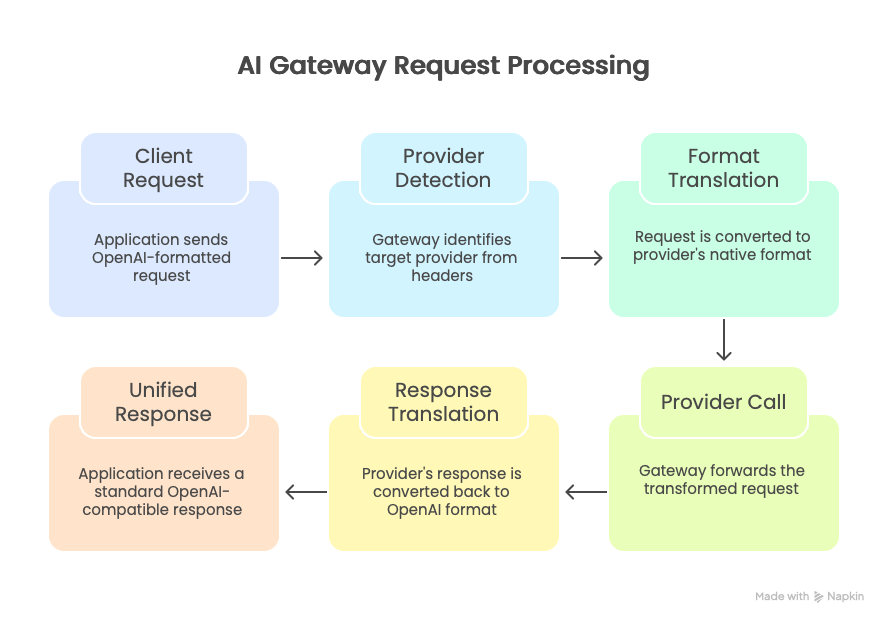
Supported Providers
Implementation Examples (for Each Provider)
All examples use the OpenAI SDK with provider specific headers to route requests through the AI Gateway.
OpenAI
Access OpenAI’s GPT models made available by OpenAI APIopenai_example.py
Anthropic
Access Anthropic Claude models made available by Anthropic APIanthropic_example.py
Amazon Bedrock
Access Amazon Bedrock models made available by AWS Bedrock APIbedrock_example.py
Azure OpenAI
Access Azure OpenAI models made available by Azure OpenAI APIazure_openai_example.py
Azure AI Inference
Access Azure AI Inference models made available by Azure AI Inference APIazure_ai_inference_example.py
Google AI
Access Google Gemini models made available by Google AI APIgoogle_ai_example.py
Google Vertex AI
Access Google Vertex AI models made available by Google Vertex AI APIgoogle_vertex_ai_example.py
Request Metadata
The Unified API supports an optionalmetadata field in requests to enrich request context with user, team, and tenant information. This metadata enables enhanced tracking, reporting, and governance by associating requests with organisational context.
Metadata Structure
The metadata object supports the following structure:Using Metadata in Requests
Metadata can be included in any API request. Here’s an example:metadata_example.py
All metadata fields are optional. You can include only the metadata fields relevant to your use case. The metadata field works with all supported providers.